
Project Report
Think like a President
Report by:
Aninakwah Vera Yeboah
December 1, 2025
Citation
Quansah, S., Asante, V., Aninakwah, V. Y., Debrah, A. B., & Nsiah, N. A. A. (2023)
Tags
Abstract
This project explored a participatory learning model through an activity titled “Think Like a President”, where 68 learners (50% male, 50% female), aged 7–15, engaged as co-researchers and co-designers to solve real-world problems using the Sustainable Development Goals (SDGs). Assigned different African countries, learners identified pressing challenges, selected a relevant SDG, and collaboratively co-designed development strategies rooted in SDG 17 – Partnerships for the Goals.
Learners took on active roles as national leaders, designers of change, and policy visionaries. Through participatory design, learners localized global issues, imagined innovative partnerships, and presented their solutions at a simulated Global Leaders Summit.
This approach was grounded in constructivist theory (Piaget) and social constructivism (Vygotsky), positioning learners as agents of their own meaning-making, while also aligning with critical pedagogy (Freire) by engaging them in authentic, socially-relevant problem solving.
By shifting learning from content consumption to creative co-design, this project fostered agency, systems thinking, and a stronger sense of civic identity.
1.0 Introduction
“Think Like a President” reimagined leadership and learning by inviting learners to take on real-world roles as national leaders tackling development challenges through the lens of the SDGs. The activity emphasized SDG 17 – Partnerships for the Goals, framing partnerships not just as content to be studied but as designable, adaptable tools that learners could critically apply.
Treating learners as co-researchers and designers, this approach encouraged deep inquiry, collaboration, and civic imagination. It aligned with the principles of participatory design, where learners help shape outcomes, learning processes and tools used to get there.
2.0 Method
2.1 Learners
- Total learners: 68
- Gender representation: 34 males (50%), 34 females (50%)
- Age range: 7–15 years
2.2 Mode of Delivery
- Virtual Live Sessions
- Introduced learners to the SDGs and facilitated real-time discussions
- In-Person Sessions
- Enabled hands-on use of printed materials
- Learners conducted digital research on their assigned countries and connected these contexts to relevant SDGs
- Enabled hands-on use of printed materials
3.0 Results
3.1 Learning Outcomes
Learners demonstrated growth in several key areas:
- Agency and Co-Creation with SDG Tools
- Learners were empowered to take initiative and co-create solutions using SDG-aligned tools. This reflected Constructivist Theory (Piaget, Vygotsky), where learners actively constructed knowledge through exploration, and Critical Pedagogy (Freire), which emphasized learning as a tool for social change.
- Empathy and Global-Local Awareness
Learners developed empathy by relating global challenges to their local context. This aligned with Social-Emotional Learning (SEL) frameworks (CASEL) and Culturally Responsive Pedagogy (Ladson-Billings), which emphasized connecting learning to students’ lived experiences and emotions. - Ownership and Identity as Global Citizens
By engaging in meaningful projects, learners saw themselves as active contributors to society. This echoed Transformative Learning Theory (Mezirow), where learners critically reflected on their role in the world, and Identity Development Theory (Erikson), which supported the formation of global citizenship identity. - Participatory Design and Systems Thinking
Learners collaborated through iterative processes to understand complex systems and design solutions. This is connected with Design Thinking in Education (IDEO, Stanford d.school) and Systems Thinking Theory (Senge), promoting problem-solving, empathy, and interconnected reasoning.
3.2 Project Activities
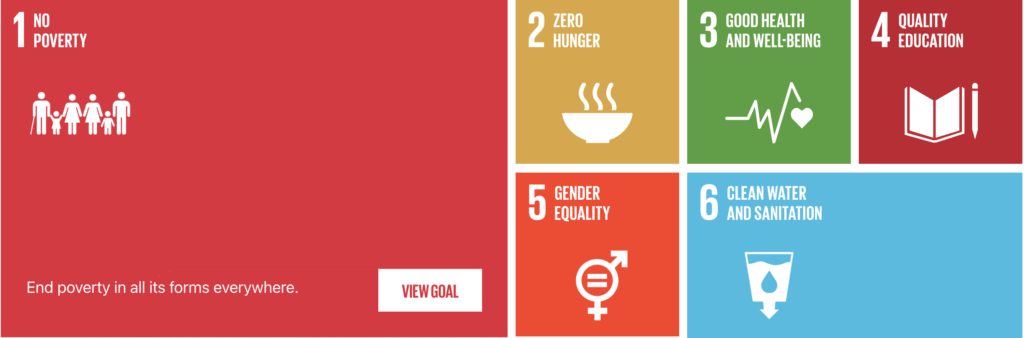
Explore the SDGs
- Posters, videos, and guided discussions introduced the 17 Global Goals
- Visual and audio tools promoted accessibility across different learning styles
https://globalgoals.org/goals/
Adopt a Country
- Each learner was assigned an African country (e.g., Ghana, Nigeria, Gabon)
- They researched their country’s social, economic, and environmental challenges
Select an SDG & Design a Strategy
- Learners chose an SDG relevant to their country’s challenges
- They mapped out action plans involving global and local partnerships (aligned with SDG 17)
Present at a Simulated Global Leaders Summit
- Learners role-played world leaders, presenting their countries’ problems and partnership-based solutions
3.3 Materials Used
- Sustainable Development Goal Posters
- A4 paper, markers, pencils, sticky notes
- Laptops and Internet access for digital research
4.0 Discussion
4.1 Impact of Learning Activities
Confidence and Voice:
Learners gained confidence in presenting their ideas and leading team discussions. They communicated their strategies clearly and took ownership of their work.
Global Competence:
Learners showed an understanding of global challenges and how they manifest locally. By researching issues in their assigned African countries, they demonstrated awareness of how problems in one part of the world can affect other parts.
Ownership and Purpose:
Learners expressed pride in designing actionable plans that reflected empathy, civic responsibility, and a desire to make meaningful change in their assigned countries.
Empathy and Agency:
Becoming co-creators of their learning experiences, learners moved from passive recipients to active problem-solvers.
Purposeful Learning:
Learners saw learning not just as schoolwork, but as a way to make life better for people in their communities and beyond.
5.0 Feedback and Reflections
This project validated the idea that design-based learning is more than an instructional method, it’s a civic practice. Learners didn’t wait to be told what to do. Instead, they led with curiosity, designed with purpose, and shared ideas to address the issue of the assigned country.
The SDGs became thinking tools and building blocks, shaped by the learners’ perspectives, research, and collaboration. This approach echoes Seymour Papert’s constructionism, where learning happens most powerfully when learners are actively making meaningful artifacts.
6.0 Challenges Faced
- Limited prior knowledge of some African countries required additional support
- Short activity timeline reduced opportunities for iteration and refinement
- Unstable internet connectivity adversely affected the flow of the sessions.
7.0 Conclusion
“Think Like a President” affirmed that learners, when positioned as co-researchers and designers, are capable of engaging deeply with global challenges and designing imaginative solutions.
This participatory approach transforms learning from transmission to transformation, anchoring it in empathy, agency, and civic identity. It offers a scalable model for inclusive, SDG-centered education rooted in child leadership and co-design.
8.0 Contributors
- Sam Quansah – Principal Investigator & Curriculum Designer & Curriculum Designer
- Vera Yeboah Aninakwah – Lead Facilitator & Code Developer
- Nana Adwoa Nsiah – Instructional Facilitator
- Victor Ofori Asante – Instructional Facilitator
9.0 References
- United Nations Sustainable Development Goals – https://sdgs.un.org/goals
- Vygotsky, L. S. (1978). Mind in Society
- Micro:bit SDG Learning Resources – https://microbit.org/projects/sdg/
Related Project Reports
Show How You Feel
Using principles of event handling and algorithmic thinking, learners developed a sense of agency in creating digital tools rather than simply consuming them.
Flash How You Feel
Creating flashing emoji displays that represented their emotions, reinforcing prior learning in event handling and algorithmic thinking while adding iterative control flow to their programming toolkit.
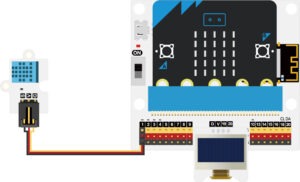
Monitoring Environmental Temperature
This experience supported digital literacy through coding and sensor use, scientific inquiry through real-world data collection and comparison, and environmental awareness by connecting learners’ observations to broader patterns.
Traffic Light System
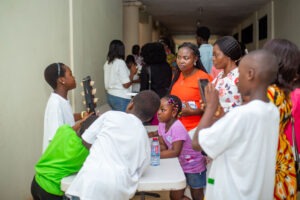
The activity was anchored in an authentic local context, addressing traffic congestion challenges at Kotokuraba Market in Cape Coast.
Energy-Efficient Streetlight
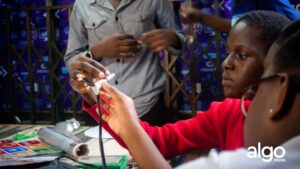
The activity was anchored in an authentic local context, addressing traffic congestion challenges at Kotokuraba Market in Cape Coast.

Debugging of the Energy-Efficient Streetlight
Learners applied active recall to retrieve prior knowledge from a previous streetlight programming activity and transfer it to the debugging process.