Project Report

Traffic Light System

Report by:

Aninakwah Vera Yeboah

December 2, 2025

Citation

Quansah, S., Asante, V., Aninakwah, V. Y., Debrah, A. B., & Nsiah, N. A. A. (2023)

Abstract

This project engaged 68 learners aged 7–15 in foundational electronics and hardware programming by guiding them to design and prototype a traffic light system. Leveraging the BBC micro:bit’s General Purpose Input/Output (GPIO) pins, learners constructed simple LED circuits to simulate the operation of a traffic control system. The activity was anchored in an authentic local context, addressing traffic congestion challenges at Kotokuraba Market in Cape Coast, thereby enhancing the relevance and applicability of learning.

Through this process, learners developed digital literacy, circuit design skills, and systems thinking, while also engaging in problem-based learning to explore how technology can be applied to urban infrastructure challenges. The initiative aligned with the Sustainable Development Goals (SDG) 4: Quality Education, SDG 9: Industry, Innovation, and Infrastructure, and SDG 11: Sustainable Cities and Communities.

1.0 Introduction

Traffic congestion is a pressing issue in many urban markets, including Kotokoraba Market in Cape Coast. Kotokoraba Market is considered the largest market in Cape Coast. However, learners at Algo Peers have observed that the roads and streets around the market are consistently busy, congested, and poorly regulated. According to these learners, such conditions can increase the risk of road accidents, contribute to lateness, reduce productivity, and facilitate the spread of diseases.

In this project, learners explored how microcontroller-based systems can help regulate traffic flow by simulating a traffic light system. They were introduced to the micro:bit’s GPIO pins, interfaces that allow the microcontroller to send and receive signals from external components, and examined their real-world applications in automation and control systems. Learners then applied this knowledge to design and program LED-based circuits replicating the operation of a traffic light.

Grounded in Constructionism (Papert, 1980), which emphasizes learning through creating meaningful artifacts, learners actively built and programmed their traffic light prototypes, making abstract concepts tangible. Additionally, the project incorporated Problem-Based Learning principles (Barrows, 1986), situating learners in an authentic, community-centered problem that required critical thinking and collaboration. This pedagogical approach encouraged learners to develop computational thinking skills, systems understanding, and civic responsibility by addressing a real-world challenge in their own environment.

2.0 Method

2.1 Learner Demographics

  • Total learners: 68
  • Gender representation: 34 males (50%), 34 females (50%)
  • Age range: 7–15 years
  • Learners aged 7–9: Used block-based coding
  • Learners aged 10–15: Used Python programming

2.2 Mode of Delivery

  • Virtual Live Sessions: Introduction to GPIO pins, discussion of how traffic lights work, and exploration of real-world applications of automated control systems.

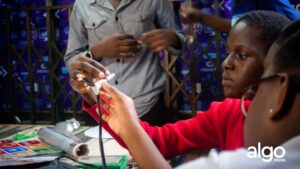
  • In-Person Sessions: Hands-on circuit-building with LEDs and BBC micro:bits, programming light sequences, and connecting designs to the traffic congestion problem at Kotokuraba Market.

3.0 Results

3.1 Learning Outcomes

  • Learners understood the purpose and operation of GPIO pins.

  • Learners gained practical experience in building simple circuits with LEDs.

  • Learners learned to program traffic light sequences using timers and conditional logic.

  • Learners developed problem-solving skills by connecting technical knowledge to a local infrastructure challenge.

3.2 Project Activities

  • Introduction to micro:bit hardware and pin functions.

  • Explanation of GPIO and its role in automation systems.

  • Circuit design and wiring of red, yellow, and green LEDs.

  • Programming sequential light changes to simulate a real traffic light.

  • Group discussions on how such systems could be implemented to reduce congestion at Kotokuraba Market.

3.3 Materials Used

  • BBC micro:bit
  • Breadboards and jumper wires
  • LEDs (red, yellow, green) and resistors
  • Computers with MakeCode and Python editors
  • Tinkercad for Digital Prototyping
  • Instructional Guide

3.4 Project Code Repository

Learners used BBC micro:bit and Microsoft MakeCode/Python to program the traffic light system with timing sequences and event handling concepts.

4.0 Discussion

STEAM Learning as a Catalyst for Local Problem-Solving:
Learners actively applied STEAM knowledge to design practical solutions addressing real challenges in their communities. Creating prototypes that simulate traffic management at Kotokuraba Market, learners connected abstract classroom concepts with tangible urban issues, demonstrating how STEAM empowers them to become problem solvers rooted in their local context.

Nurturing Agency through Authentic Learning Environments:
The project fostered a learning environment where learners exercised ownership over their designs, encouraging creativity and self-confidence. Opportunities to program and customize their systems cultivated critical thinking, enabling learners to navigate design constraints and community needs. This authentic, hands-on approach mirrors real-world engineering processes, making learning meaningful and relevant.

Development of Critical STEAM Skills for Community Impact:
Engaging with programming, circuit design, and hardware-software integration, learners strengthened their computational thinking, sequencing, and debugging skills. These STEAM competencies, applied within a community-focused framework, helped learners build technical expertise that enhanced their problem-solving capacity to address scalable, real-world challenges.

5.0 Feedback and Reflections

Learners expressed excitement at creating a functional device similar to those used in real roads and intersections.

The facilitator observed that taking the problem from a real location in their community made learners more invested and motivated to find solutions.

6.0 Challenges Faced

  • Unstable internet connectivity adversely affected the flow of the sessions.

    Limited access to computers required some learners to wait for their peers before coding on the micro:bit, resulting in session delays and a disrupted flow.

  • Limited resources, such as wires, LEDs, and components, made it difficult for learners to design the physical structure of their traffic light system, even though the system functioned fully.

7.0 Conclusion

The Traffic Light System project effectively integrated electronics, programming, and authentic problem-solving in a community context. Learners deepened both their understanding of STEAM concepts and their appreciation for technology’s role in addressing urban challenges. This aligns with educational research showing that authentic, problem-based learning fosters transferable problem-solving skills, civic awareness, and sustained engagement.

8.0 Contributors

  • Sam Quansah – Principal Investigator & Curriculum Designer & Curriculum Designer
  • Vera Yeboah Aninakwah – Lead Facilitator & Code Developer
  • Nana Adwoa Nsiah – Instructional Facilitator
  • Victor Ofori Asante – Instructional Facilitator

9.0 References

  • Papert, S. (1980). Mindstorms: learners, Computers, and Powerful Ideas.

  • Barrows, H. S. (1986). A taxonomy of problem-based learning methods. Medical Education, 20(6), 481–486.

  • Wing, J. M. (2006). Computational thinking. Communications of the ACM, 49(3), 33–35.

  • Jonassen, D. H. (2011). Learning to Solve Problems: A Handbook for Designing Problem-Solving Learning Environments. Routledge.

  • United Nations (2015). Sustainable Development Goals – Goal 4: Quality Education; Goal 9: Industry, Innovation and Infrastructure; Goal 11: Sustainable Cities and Communities.

Related Project Reports

Show How You Feel

Using principles of event handling and algorithmic thinking, learners developed a sense of agency in creating digital tools rather than simply consuming them.
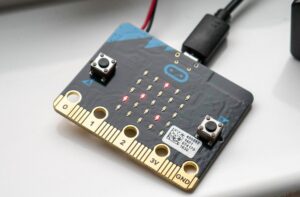
Flash How You Feel

Creating flashing emoji displays that represented their emotions, reinforcing prior learning in event handling and algorithmic thinking while adding iterative control flow to their programming toolkit.
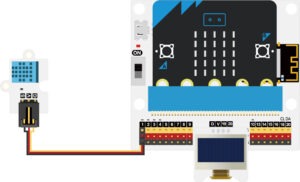
Monitoring Environmental Temperature

This experience supported digital literacy through coding and sensor use, scientific inquiry through real-world data collection and comparison, and environmental awareness by connecting learners’ observations to broader patterns.
Energy-Efficient Streetlight

The activity was anchored in an authentic local context, addressing traffic congestion challenges at Kotokuraba Market in Cape Coast.